· Sylvie — Smart Funnel Lab
Treatment Course: How to Get Your Clients Back for Every Session
You sold the course. Your client said yes, and she came to the first session. Then, as the weeks go by, something happens — or rather, doesn't happen. She's slow to book again. She postpones. She ends up spacing out her sessions without really having decided to. Every session postponed without notice becomes a no-show, and a lost slot.
This isn't a rare situation. And it's neither your fault nor hers.
Between the first session and the last, there's a gap. A gap in which everyday life takes over again, schedules fill up with other things, and the course — though paid for, though already begun — loses ground without anyone noticing in time.
What this article offers isn't a sales technique. It's a way of organizing your follow-up so your clients come back for every planned session, without you having to pick up the phone every week to contact them one by one.

Selling a Treatment Course Doesn't Guarantee the Client Will Return for Every Session
Selling a course is one step. But it's not the end of the journey. The real challenge begins the moment the client leaves after the first session.
What Happens Between Two Appointments (Without You Seeing It)
Between two sessions, your client goes home. She goes back to her daily life — work, family, obligations. The next session is in a few days or a few weeks. She thinks about it, then stops thinking about it. This isn't a sign of disinterest. It's simply what happens when nothing in her environment reminds her that the moment is approaching.
On your end, you're in the treatment room. You have other clients to welcome, other sessions to prepare, other messages to answer at the end of the day. Following up on every ongoing course has no place in an already packed schedule.
And that's when sessions start to space out.
The Client Doesn't Forget Your Salon: She Simply Forgets It's Time
There's an important difference between a client who gives up and a client who postpones.
The one who gives up has decided not to continue. The one who postpones hasn't decided anything at all. She's just let the moment pass without anyone or anything signaling to her that it was now.
Very often, clients who space out their treatment sessions aren't dissatisfied. They simply didn't get the signal at the right time. And since no one reminded them their next session was coming up, they let the days go by.
It's an organizational problem, not a motivation problem.
Why Clients Space Out Their Sessions During a Treatment Course
Understanding why a session is missed or postponed is already a step towards knowing how to prevent it.
She Meant to Book Again Herself… and It Didn't Happen
At the end of a session, the client is relaxed and satisfied. She leaves with every intention of booking again soon. But a good intention, without a reminder and without a set date, often remains just an intention.
The days go by. She tells herself she'll do it tomorrow. Tomorrow becomes next week. And next week becomes a blank space in your schedule.
This isn't carelessness. It's simply what happens when booking an appointment relies entirely on the client's own initiative — with nothing to support her in taking that step.
No One Told Her Her Next Appointment Was Coming Up
In a well-organized treatment course, the client shouldn't have to remember the date of her next session on her own. That reminder should reach her naturally, at the right time, without her having to think about it.
But when that reminder doesn't exist — because you didn't have time to send it, because you made a mental note but didn't write it down — the client has no outside signal telling her the time has come.
She waits, without really waiting. And the session doesn't happen.
The Course Isn't Finished, but Nothing Is Moving It Forward
A treatment course is a journey. The client has started it. She knows the following sessions are part of what she bought. But if nothing in that journey creates continuity — no appointment booked, no message sent, no visible follow-up — the course gradually becomes something abstract.
It exists in your client file. But in your client's daily life, it has lost its place.
What You Can Do Without Picking Up the Phone
The solution isn't to call each client individually. That would be time-consuming, hard to sustain over time, and hardly compatible with a day spent in the treatment room. The solution is to organize follow-up in advance — before the session is even missed.
Get the Next Session Booked Before the Client Leaves
The best way to prevent a missed session is to schedule it before the client leaves the salon.
Ideally, as soon as the course is purchased, all sessions are planned together. Your client leaves with her dates. She knows exactly when she's coming back. And you know exactly what your schedule looks like for the coming weeks.
If full planning isn't possible from the start, at least get the next session booked at the end of each appointment, before the client walks out the door. This moment — right after the session, when she's satisfied and available — is the easiest time to set a date together. A date on the calendar is worth far more than an intention.
Plan the Reminder as Soon as the Previous Session Ends
Once the next session is set, the reminder can be scheduled immediately. You don't have to remember it on the day. You set up the reminder the moment you note the appointment, and it goes out automatically at the right time.
This may seem minor, but it's often what makes the difference between a session kept and a session forgotten. The reminder isn't a gimmick. It's the continuity of your follow-up, made visible to your client.
What a Treatment Course Reminder Message Should Say (and Shouldn't Say)
A good reminder message is simple. It states the date and time of the next session. It gives the client the chance to confirm or let you know if something comes up. It's warm without being pushy.
What it shouldn't do: feel like a sales follow-up, make the client feel guilty if she hasn't replied yet, or bury the essential information in an overly long text.
A short, clear, personalized message — with the client's first name and the exact date — is enough. It's not a promotional email. It's a small sign that you're thinking of her and that her session is indeed scheduled.
Adjust the Reminder Timing to Your Type of Treatment Course
The right time to send a reminder depends on the pace of your course.
For a course with sessions spaced a few days apart, a reminder the day before or two days ahead may be enough. For a course with sessions spaced two to three weeks apart — such as certain radiofrequency or facial treatment protocols — a first reminder can be sent a few days ahead, with a possible second message the day before.
The goal isn't to send more messages, but to place the reminder at the moment it's useful: early enough for the client to plan ahead, close enough to stay fresh in her mind.
Organizing Follow-Up When You Work Alone: What It Changes
Working alone in a beauty salon means handling treatments, reception, messages, booking appointments, and following up with every client currently undergoing treatment, all at the same time. Following up on treatment courses adds to that list — and it's often the first thing to slip when the schedule is full.
Manual Follow-Up: Why It Doesn't Hold Up Over Time
Following up on your courses manually is possible when there are only two or three in progress. You note the dates in a notebook, you check every week who's expected the following week, you send a message when you remember to.
But as the number of ongoing courses grows, or when a busy week makes you forget the weekly check, manual follow-up falls apart. Not because you lack diligence, but because it relies entirely on your memory and on time you don't always have.
Manual follow-up depends on you. What you want is follow-up that works even while you're in the treatment room.
What an Automated System Makes Possible for Treatment Course Follow-Up
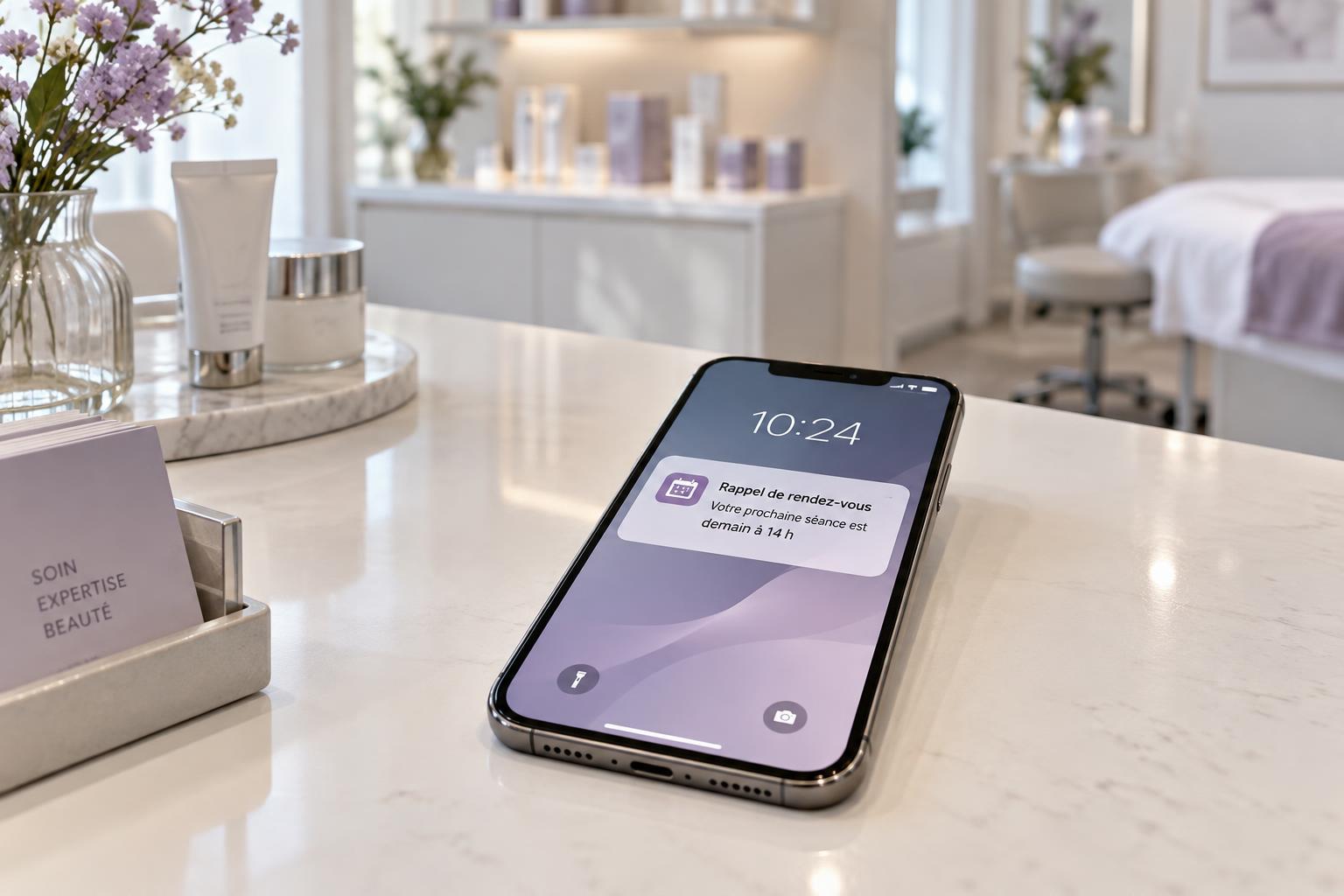
Automated follow-up is a set of messages that go out on their own, at the right time, without you having to think about it.
Once a session is booked, the reminder is scheduled. As the date approaches, the message goes out. If the client doesn't respond after a missed session, a follow-up message can go out a few days later.
You no longer manage the when or the how. You set up the system once, and it runs. Your clients receive their reminder, and you stay focused on your treatments.
It's not magic. It's organization.
You Don't Need to Be Tech-Savvy for This to Work
Faced with this kind of organization, many beauty salon managers share one fear: the technology. The impression that it's complicated to set up, that it takes time, that it won't suit the way they work.
That's understandable. But it doesn't have to be that way. A good follow-up system is designed so you don't have to manage its day-to-day operation. It's set up once — ideally with support tailored to your salon — and it then does the work for you.
What Your Clients Expect Between Two Sessions (Without Necessarily Saying So)
Your client doesn't expect you to call her every week. She doesn't expect a detailed program or complex follow-up either. What she expects is something much simpler.
A Sign That You're Thinking of Her
A reminder message, even a short one, tells your client something important: you thought of her. Her next session isn't just another appointment in an anonymous schedule. It's follow-up, attention, continuity.
This simple gesture — reminding her of an appointment — nurtures the relationship. It shows that you take your role seriously and that your client's treatment course isn't left to fend for itself once she walks out the door.
It's not solicitation. It's care, in the broadest sense.
A Concrete Reason Not to Postpone
Your client's daily life is full of good reasons to postpone. A sick child, a meeting that runs long, a busier week than expected. Without a reminder, without an outside signal, these reasons easily win out over the appointment.
A well-timed reminder message rebalances things. It gives your client a concrete reason to come: she received a message, she confirmed, the session is on her calendar. The course takes back its place in her daily life.
It's not up to her to remember to come back. It's your follow-up that reminds her it's time.
Where to Start If You're Beginning from Scratch
If your treatment course follow-up is still entirely manual, you don't need to change everything at once. There's a clear first step, and one concrete thing you can test quickly.
The First Thing to Put in Place
Before even thinking about automation, start with a simple rule: at the end of every treatment session, the next session is booked before the client leaves.
It's an organizational habit, not a technical tool. It requires no software, no setup. It just requires making it a routine at the end of each session.
If you already have this routine, you have the foundation. The next step is to make sure every booked appointment comes with a reminder — sent automatically, without you having to think about it on the day.
What You Can Test This Week
Look at your ongoing treatment courses. For each one, ask yourself two simple questions:
- Is the next session already scheduled in your calendar?
- Is a reminder planned for this client before that session?
If the answer is no to either of these two questions for one of your clients, that's where you start. Not with a complete overhaul of your organization, but with this specific point, for this client, this week.
That's how you build solid follow-up: one treatment course at a time.
FAQ: Your Questions About Following Up With Clients During a Treatment Course
Conclusion
Follow-up on a treatment course is what happens between the first session and the last. That's where your clients' consistency is decided. And that's where organization makes all the difference.
If your clients don't come back, it's not because they don't want to. It's because nothing in their daily life reminded them it was time. A session booked in advance, a well-timed reminder, a follow-up message that goes out on its own as the date approaches: that's what helps a sold treatment course become a treatment course completed to the end.
When you work alone, you can't handle everything yourself. But you can organize things so follow-up runs without having to think about it every week.